There are rare snowmobiles, and then there are snowmobiles that simply no longer exist.
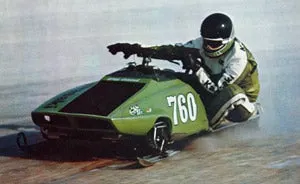 The 1977 Kawasaki Shark and Bombardier Aaardvark belong in a category all by themselves. Every original factory machine was intentionally destroyed. None escaped. None found their way into museums. None were quietly tucked away in the corner of a dealership warehouse. They were built for one purpose, raced for one season, and then deliberately erased from history.
Today, every Shark you see is a modern re-creation built from photographs, magazine articles, dimensions, and the memories of the people who saw the originals. They are remarkable pieces of craftsmanship, but they are not restorations because there were no original Sharks left to restore. The same is true of the Bombardier Aaardvarks. Doug Hayes and other Bombardier factory personnel watched as the Ski-Doo and Moto-Ski factory race sleds were cut apart, crushed, and buried after the season ended. Every one of them was destroyed.
Ironically, their disappearance may be exactly why they’re remembered today.
A Sport on the Verge of Change
Most people remember the 1977 Sno Pro season as the year Polaris dominated factory racing with the Midnight Blue Express. Looking back nearly fifty years later, it’s easy to assume Polaris entered the season as the favorite.
Nothing could be further from the truth.
Prior to the 1977 season, the odds on favorite to dominate was Arctic Cat. Their 1976 season had been spectacular, and there was every reason to believe they would remain the benchmark in Sno Pro racing.
But while the fans were talking about horsepower and drivers, something much more important was happening behind the scenes.
The engineers had discovered that the future wasn’t going to be determined by engines.
It was going to be determined by suspension.
The Race That Changed Everything
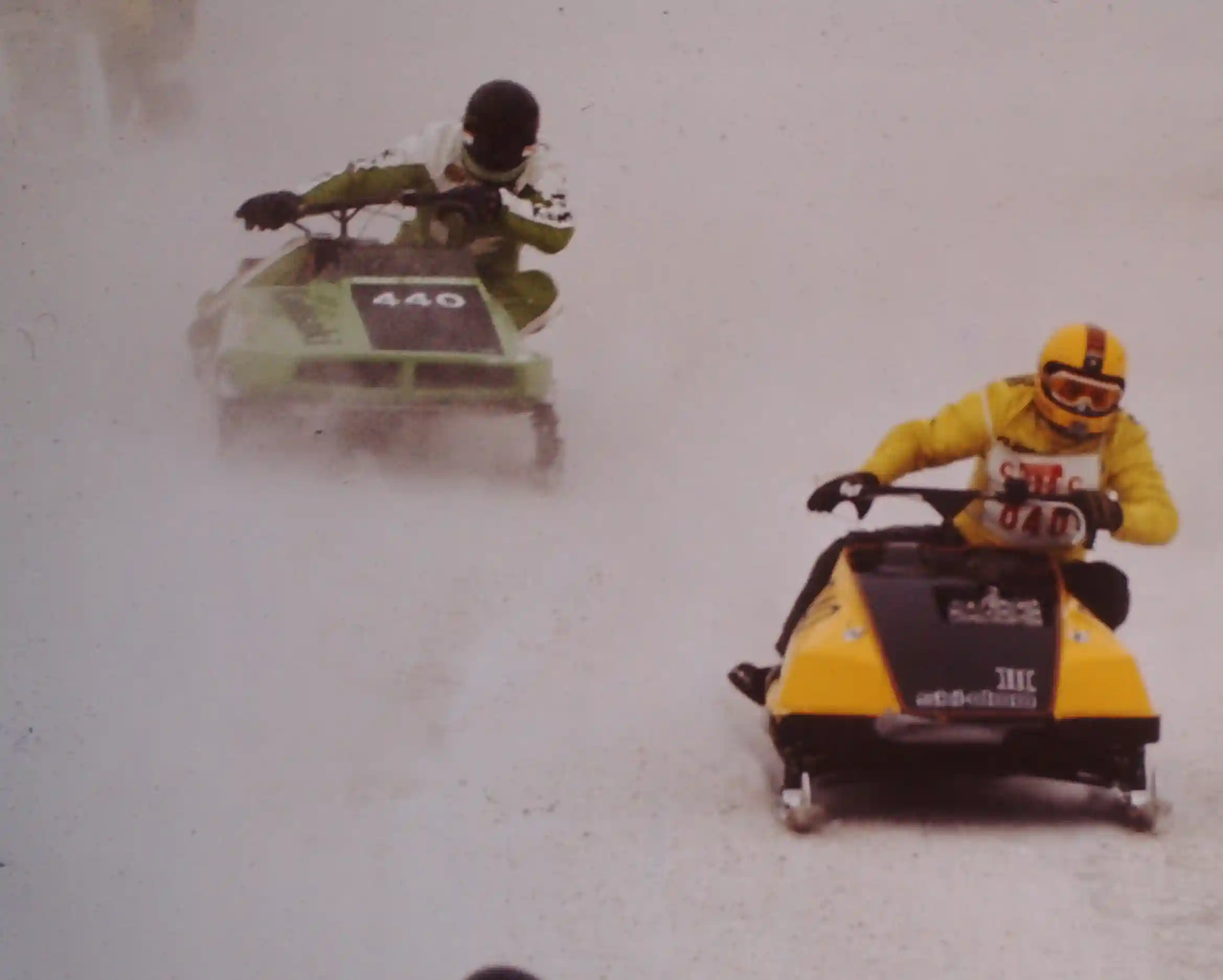 The turning point came at Lancaster, New Hampshire, during the 1976 Sno Pro season.
The track was brutally rough. Every bump upset the sleds, every corner punished the suspension, and every lap separated machines that merely had horsepower from those that could actually put it to the ground.
Gilles and Jacques Villeneuve arrived with factory Skiroules that looked different from almost everything else in the field. Hidden beneath the bodywork was a feature that very few racers had seen in competition: independent front suspension.
Until then, virtually every serious race sled relied on a leaf spring front suspension. It had been the standard for years. It was relatively simple, lightweight, and familiar. But like every mature technology, it had reached the point where incremental improvements were becoming harder to find.
The Villeneuve brothers demonstrated something completely different.
As the race unfolded, their machines carried noticeably more speed through the rough sections of the course. Where other sleds bounced, darted, and forced their drivers to back off the throttle, the Skiroules remained composed. They weren’t simply faster on the straightaways. They were dramatically quicker through the corners, and over the course of a race those extra miles per hour translated into enormous gains.
It wasn’t horsepower that impressed everyone watching.
It was control.
Among the observers that day were Polaris Racing Manager Bob Eastman, race engineer Wes Pesek, and mechanic Jerry Bunke. Polaris wasn’t racing at Lancaster, but they were paying very close attention. They weren’t the only ones. Across the Sno Pro world, factory engineers had just witnessed something that couldn’t be ignored.
Independent front suspension wasn’t an interesting experiment anymore.
It was the future of factory racing.
The Engineering Arms Race Begins
The months that followed became one of the most remarkable periods of innovation the snowmobile industry has ever seen.
Every major manufacturer arrived at essentially the same conclusion. If they intended to win the 1977 Sno Pro championship, last year’s technology wasn’t going to get them there.
Kawasaki looked to Jacques Villeneuve, whose experience with the Skiroule program made him uniquely qualified to help develop a new generation of factory racers.
Bombardier quietly began work on two entirely new factory race sleds, one carrying Ski-Doo colors and another representing Moto-Ski. Although they wore different paint, they shared the same ambitious engineering philosophy.
Polaris made perhaps the most significant move of all by bringing independent racer Gordon Rudolph into its racing program. Rudolph had already proven the effectiveness of independent front suspension on his own home-built race sleds. His ideas, combined with the resources of the Polaris engineering team, would eventually become the Midnight Blue Express.
It is fascinating to look back on that winter because every factory reached the same conclusion independently.
Nobody copied the winner.
There wasn’t a winner yet.
Instead, four different engineering teams all recognized that the future of snowmobile racing had suddenly changed, and they raced against the calendar to build the machines that would define the 1977 season.
Meet the Shark
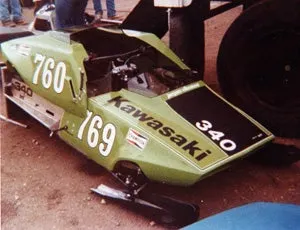 By the time the 1977 Sno Pro season arrived, Kawasaki had committed itself to one of the most ambitious racing programs in its history.
At the center of that effort was Jacques Villeneuve.
Already regarded as one of the finest snowmobile racers in the world, Villeneuve brought something just as valuable as his driving ability. He had firsthand experience with independent front suspension from the revolutionary Skiroule factory program. Kawasaki understood that if anyone knew what an IFS race sled should feel like at racing speed, it was Jacques.
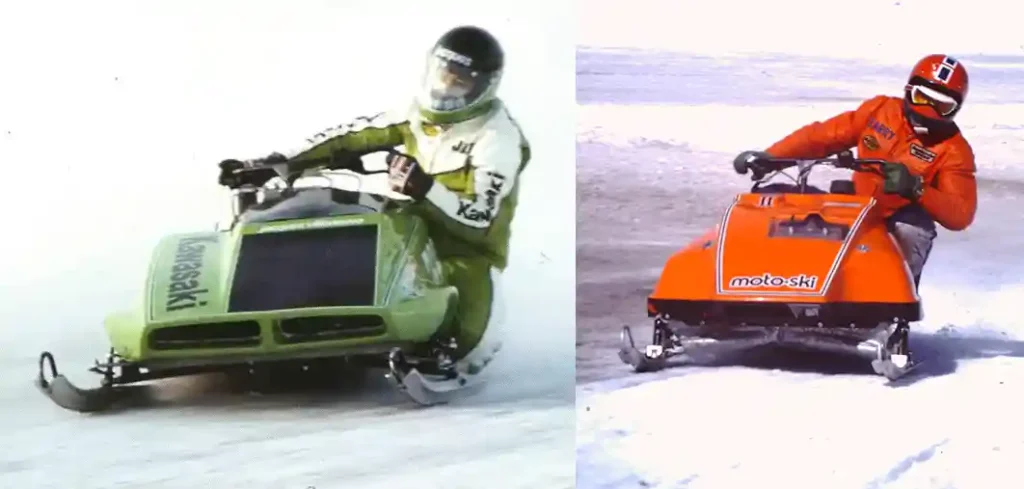
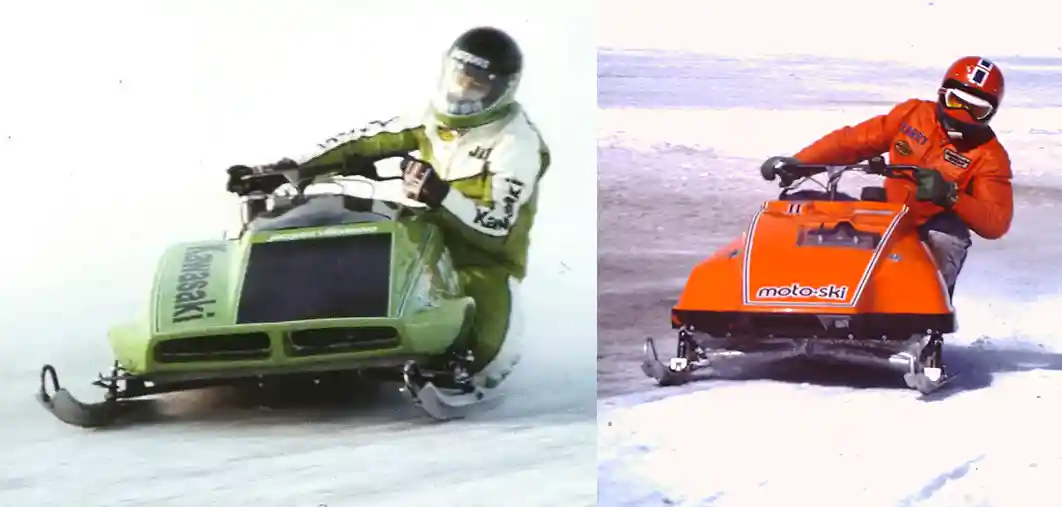
Alongside teammate Greg Channel, Villeneuve piloted what became known simply as the Shark.
The name fit.
With its sleek bodywork and low, aggressive stance, the Shark looked unlike almost anything else on the Sno Pro circuit. More importantly, it represented a completely different philosophy. Rather than refining existing technology, Kawasaki started with a clean sheet of paper. The independent front suspension was the centerpiece, but it wasn’t the only innovation. Lightweight construction, liquid cooling, carefully developed chassis geometry, and numerous factory-only components combined to create one of the most technically advanced race sleds of its era.
Like every factory race sled of the period, the Shark wasn’t intended for trail riders. It wasn’t designed to be sold through dealerships, nor was it built with long-term durability in mind. It existed for one reason: to win Sno Pro races.
Meet the Aaardvark
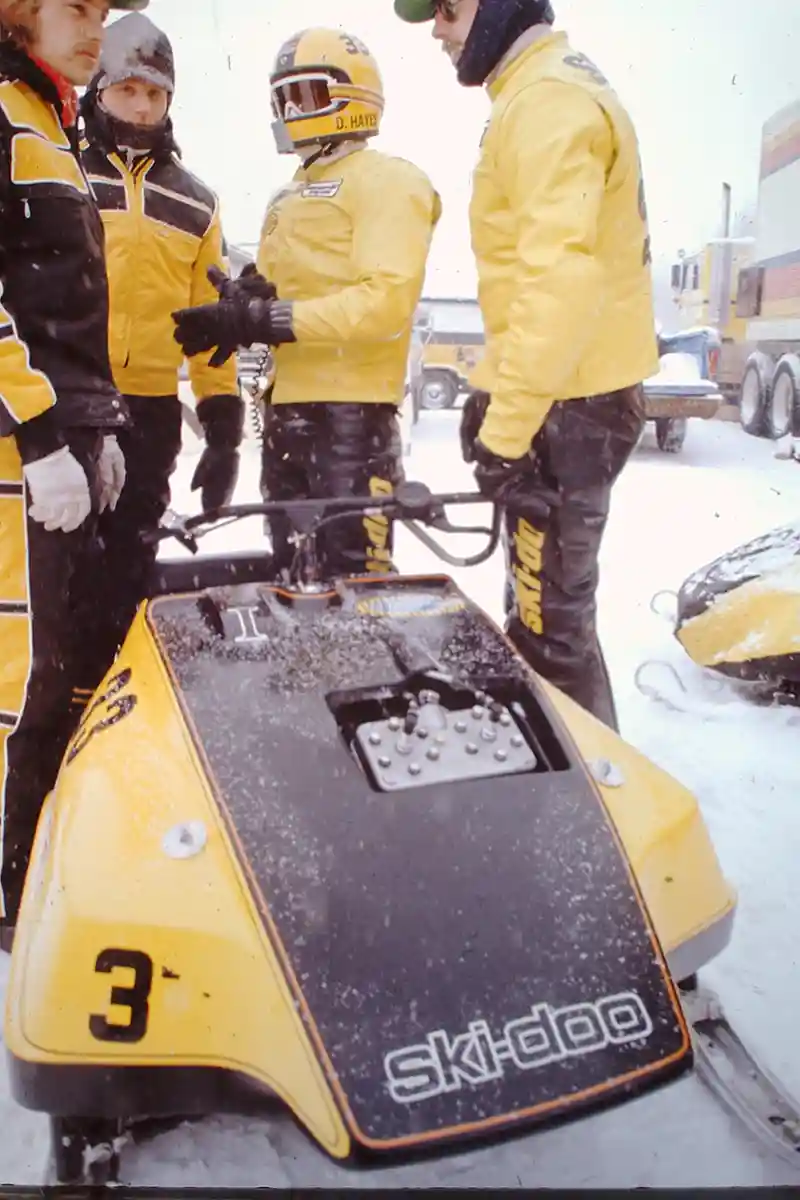 Bombardier reached many of the same conclusions, but took a slightly different path.
Rather than producing a single factory race sled, the company developed two nearly identical versions. The yellow Ski-Doos represented the Ski-Doo factory team, while the orange machines carried Moto-Ski colors. Mechanically, they shared the same revolutionary ideas. Visually, they allowed Bombardier to promote both of its snowmobile brands on the national racing circuit.
Doug Hayes and Ed Schubitzke raced the yellow Ski-Doos in Sno Pro competition, while Larry Rugland campaigned the orange Moto-Ski machines. Although fans often remember them simply as “the Aaardvarks,” there were actually two distinct factory teams representing the same engineering effort.
Like the Shark, the Aaardvark featured independent front suspension, liquid cooling, lightweight construction, and countless one-off racing components that would never appear on a production snowmobile. These weren’t modified trail sleds. They were purpose-built race machines developed specifically for factory competition.
Even today, the styling looks futuristic. The low profile, narrow bodywork, and suspension layout seem years ahead of the machines they lined up against in 1977.
How Many Were Built?
One of the enduring mysteries surrounding both the Shark and the Aaardvark is exactly how many were produced.
Unfortunately, no complete factory records have surfaced, leaving historians to piece together the answer from photographs, race reports, and the recollections of the people who were there.
Based on how Sno Pro racing operated in 1977, it’s possible to make some educated guesses.
Each factory rider would have needed separate sleds for the various engine classes. Bombardier competed in the 250, 340, and 440 classes, making it reasonable to assume that Doug Hayes, Ed Schubitzke, Larry Rugland, and the other factory riders each had multiple race sleds available throughout the season. Kawasaki appears to have concentrated primarily on the 340 and 440 classes, although there may also have been specialized machines built for events such as the 440X class.
Just as important were the spare sleds.
Factory teams didn’t travel across North America with only one chassis per rider. Racing is hard on equipment. Crashes happened. Frames bent. Suspensions broke. Engines failed. Every serious factory team almost certainly transported backup chassis so a rider could be back on the starting line if disaster struck.
Those spare sleds represented hundreds of hours of engineering and fabrication. In many cases, they were every bit as advanced as the primary race sleds.
Sadly, they shared the same fate.
When the factories decided these machines had served their purpose, they didn’t preserve the race sleds and destroy the backups.
They destroyed everything.
A Winter Filled with Optimism
It’s easy to let history influence the way we remember 1977. Because Polaris went on to dominate the season, we naturally assume everyone saw it coming.
They didn’t.
Kawasaki believed the Shark represented the next step in factory racing. Bombardier was equally confident in the Aaardvark program and the advantages its independent front suspension would provide.
Arctic Cat had every reason to believe it could build on the momentum of its outstanding 1976 season.
Polaris quietly arrived with the Midnight Blue Express and its own interpretation of independent front suspension, developed with the help of Gordon Rudolph.
The remarkable thing is that all four manufacturers had reached the same conclusion: Horsepower alone wasn’t going to decide the next championship, corner speed was.
The engineers had finally recognized what Gilles and Jacques Villeneuve demonstrated so convincingly at Lancaster the previous year. Every mile per hour that could be carried through a corner reduced lap times, conserved rider energy, and created opportunities to pass. Independent front suspension wasn’t simply making sleds more comfortable to drive.
It was making them faster.
When the green flag finally dropped on the 1977 season, the greatest engineering experiment Sno Pro racing had ever seen was officially underway.
When Engineering Met Reality
Once the racing began, every factory quickly discovered that building a revolutionary snowmobile and winning races were not always the same thing.
The Shark and the Aaardvark were unquestionably among the most technologically advanced race sleds ever built to that point. Their independent front suspension systems represented a giant leap forward in handling, and both programs demonstrated that the days of relying solely on leaf springs were numbered.
But racing is rarely decided by a single innovation.
Reliability, engine performance, clutch calibration, suspension setup, rider confidence, race strategy, and countless hours of testing all played a role. As the season unfolded, one factory consistently put all of those pieces together better than anyone else: Polaris.
The Midnight Blue Express program became one of the most dominant efforts in Sno Pro history. Race after race, Polaris found itself in Victory Lane, eventually winning roughly 95 percent of the season’s major events. What had begun as an engineering battle gradually turned into a demonstration of just how well Polaris had integrated every part of its racing program.
For Kawasaki, the season was frustrating. The Shark showed tremendous promise, but it never produced the breakthrough victories the factory had envisioned. Bombardier’s Aaardvarks also demonstrated flashes of brilliance, particularly late in the season, proving that the engineering direction had been the right one even if the championship ultimately slipped away.
One of the brightest moments came at the final Sno Pro race in West Yellowstone, Montana. By then, Bombardier’s engineers and riders had gained a full season’s worth of experience with the new suspension, and the Ski-Doo team performed exceptionally well. Unfortunately, by that point the championship had already been decided.
Looking back nearly fifty years later, it’s tempting to judge these programs solely by the number of trophies they collected.
That would be a mistake.
The Shark and the Aaardvark accomplished something much more important than winning races.
They permanently changed the direction of snowmobile engineering.
Why They Disappeared
Today it’s almost impossible to imagine a factory destroying one of its premier race vehicles. Modern manufacturers carefully preserve important prototypes and championship-winning machines, often placing them in museums or corporate collections.
Snowmobile racing in the 1970s was different.
These machines weren’t viewed as historical artifacts. They were highly specialized racing tools, built to compete for one season and then replaced by something newer and faster. Once the checkered flag fell on the final race, their usefulness had come to an end.
There were several practical reasons for that decision.
First, these sleds were never intended for public ownership. They were incredibly fast, highly specialized machines built specifically for professional racers. Selling them to consumers would have created obvious liability concerns if an inexperienced rider attempted to operate them.
Second, Bombardier and Kawasaki had little reason to bring obsolete factory race sleds back to Canada or Japan after the season. Shipping them home, dealing with import duties and tariffs, and storing equipment that no longer had competitive value simply didn’t make much business sense.
There was also the issue of competitive secrecy.
Every bracket, spindle, suspension arm, chassis mount, and steering component represented hundreds of hours of development. Allowing those sleds to fall into a competitor’s hands meant giving away engineering secrets that might still prove valuable the following season.
Destroying the machines guaranteed that wouldn’t happen.
Perhaps the biggest reason of all, however, was one nobody recognized at the time.
No one thought these sleds would someday become historically significant.
In 1977, they weren’t priceless artifact: They were just last year’s race sleds.
Gone Forever
The fate of the Kawasaki Sharks is no longer a mystery.
After the season, the factory machines were crushed and buried behind Kawasaki’s facility in Shakopee, Minnesota. Years later, when the property was redeveloped, the remains were excavated and hauled to a permanent landfill.
Every original Shark was lost.
The machines occasionally displayed today are remarkable re-creations built from photographs, magazine articles, dimensions, and the memories of people who saw the originals. They deserve tremendous credit for keeping the Shark’s story alive, but they are not restorations because there were no original machines left to restore.
The Bombardier story is even more personal.
Doug Hayes and other factory Ski-Doo staff has recalled watching the Ski-Doo and Moto-Ski factory race sleds being cut apart, crushed, and buried after the season ended. Every Aaardvark, including the spare chassis that had traveled to races throughout the year, met the same fate.
Nothing was saved; not one.
Their Greatest Victory
History remembers the 1977 season because Polaris dominated it.
History should also remember it because it marked the moment snowmobile racing entered a new era.
The Shark and the Aaardvark didn’t disappear because they failed. In fact, they proved exactly what their engineers had hoped they would prove. Independent front suspension was faster. It carried more speed through rough corners, gave riders greater control, and pointed the entire sport toward the future.
Within a few years, the leaf-spring front end that had defined snowmobile racing for decades was on its way out. Independent front suspension, once considered radical, became the standard by which every high-performance snowmobile would eventually be measured.
The machines themselves were sacrificed in the name of progress.
Their ideas were not.
Nearly fifty years later, every performance snowmobile owes something to that remarkable engineering race that began on a rough track in Lancaster, accelerated through the winter of 1976-77, and forever changed the way snowmobiles were built.
The Sharks and the Aaardvarks are gone.
Their legacy is still carving corners today – well at least in our memories.